December 2024 Newsletter

General Angela Calla 3 Dec

Welcome to the December issue of my monthly newsletter!
As the end of the year approaches, I wanted to have one more check-in with you and provide some final tips for 2024! Scroll down and check out my favourite home and finance resolutions, along with some tips for decluttering your home in preparation for 2025. Have a great month!

Resolutions for Your Home and Finances

As the new year approaches, it’s a natural time to reflect on our personal goals and set resolutions for the months ahead. Your home and finances are key areas where small, intentional changes can lead to big improvements in security, stability, and quality of life.

Here are some resolutions to get you started!

Create a Realistic Home Budget

A well-planned budget is essential for financial peace of mind. Whether you’re new to budgeting or want to refine your approach, creating a realistic budget helps prioritize spending, track bills, and put money toward meaningful goals.

  • Identify Fixed and Variable Expenses: List out fixed costs, like mortgage payments, utilities, and insurance, as well as variable ones, such as groceries and entertainment.
  • Set Savings Goals: Include savings as a “non-negotiable” in your budget, earmarking funds for home repairs, investments, or emergencies.
  • Track and Adjust: Track spending throughout the month and adjust where necessary. Financial apps like Mint or You Need a Budget (YNAB) make it easier to stay on course.

Set Goals to Build Home Equity

Building home equity is a key path to increasing net worth. Whether you’re planning to sell or stay in your home long-term, building equity can offer financial flexibility and security.

  • Make Extra Mortgage Payments: Even a small additional payment toward your mortgage principal each month can shorten your loan term and reduce interest costs. A biweekly payment plan is another effective method to pay down the principal faster.
  • Consider Strategic Home Improvements: Invest in upgrades that boost home value, like kitchen and bathroom remodels, or energy-efficient upgrades like new windows or solar panels. Prioritize improvements that add the most value to your property.

Develop a Plan to Pay Down Debt

Paying down debt (especially after the holidays!) can help free up cash flow. It is key to focus on high-interest debts first, such as credit cards, to maximize your payments.

  • Use the Debt Avalanche or Snowball Method: The avalanche method involves paying off high-interest debts first, while the snowball method focuses on smaller debts first. Choose the one that best fits your motivation style
  • Consider Refinancing or Consolidation: If you have a high-interest mortgage or multiple debts, refinancing or consolidating might reduce interest rates, making debt repayment more manageable
  • Celebrate Milestones: Paying off debt can feel challenging, so celebrate progress. Every milestone achieved brings you closer to financial freedom.?

Commit to Energy Efficiency to Lower Bills

Saving on energy costs can have a significant impact on your budget, especially in colder or warmer months. Simple changes around the home can save you money while benefiting the environment!

  • Invest in Smart Thermostats: A programmable thermostat can automatically adjust heating and cooling based on your schedule, saving energy when you’re not home.
  • Switch to LED Lighting: LED bulbs use significantly less energy and have a longer lifespan than traditional bulbs.
  • Insulate Windows and Doors: Adding weatherstripping to doors and windows keeps drafts out, making your heating and cooling systems more efficient.

Review Your Insurance Policies and Coverage

Insurance is a key element of financial security, but it’s easy to forget about it until something goes wrong. As you head into the new year, this is a great time to make sure you’re fully covered!

  • Assess Homeowners and Mortgage Insurance: Review coverage limits and ensure your policy covers potential risks, including natural disasters if you live in high-risk areas.
  • Shop for Better Rates: Contact your provider for discounts or shop around for new rates. Bundling policies, like home and auto insurance, can often yield savings.
  • Update Beneficiaries and Coverage: Life circumstances change, and your insurance should reflect that. Update your beneficiaries, adjust coverage, and ensure policies align with your financial goals.

Setting resolutions for your home and finances doesn’t have to be daunting! Start with small, actionable goals to help transform your finances – and your mindset – for 2025!

12 Tips for Decluttering Your Space

Decluttering can bring a sense of calm and order to your space, especially as the holiday season approaches.


Here are some practical tips to help get organized:

  1. Start Small and Set Achievable Goals: Avoid overwhelm by breaking down the decluttering process into manageable steps. Set realistic goals, such as dedicating just 15 minutes a day to tidying up. Begin with a small area—like a single drawer or shelf—and gradually expand to larger spaces as you build momentum and confidence.
  2. Use the “One-In, One-Out” Rule: For every new item you bring into your home, make it a rule to remove an old one. This simple habit keeps your space from accumulating unnecessary items and helps maintain a balanced, organized environment.
  3. Sort and Categorize with Purpose: Sorting items as you go makes it easier to stay organized and keep track of where everything belongs. Use boxes or bins labeled “Keep,” “Donate,” “Sell,” and “Recycle/Trash” to give each item a clear destination. This method ensures that you can tackle everything in one go without second-guessing.
  4. Focus on Essentials and Joy: When deciding what to keep, ask yourself, “Does this item serve a purpose, or does it bring me joy?” If the answer is no, it’s probably time to let it go. Focusing on essentials and things that spark joy can help you make more meaningful decisions about what truly belongs in your home.
  5. Digitize Paper Clutter: Free up physical space by scanning or photographing important documents and storing them digitally. Use cloud storage or an external hard drive to keep these files secure and easily accessible. This practice reduces paper clutter and provides a backup in case of loss or damage.
  6. Declutter in Layers for Lasting Results: Tackle clutter in layers to avoid feeling overwhelmed. Start with the most obvious items—like broken or rarely used belongings—and gradually work your way through more sentimental or difficult-to-decide items. Revisiting each area multiple times helps you refine your space down to the things you truly need or cherish.
  7. Adopt a “Capsule” Mindset for Clothes and Accessories: Build a capsule wardrobe by focusing on versatile, high-quality clothing pieces that you love and regularly wear. Store out-of-season items separately to keep your main closet neat and functional. This approach simplifies decision-making and can make daily routines smoother.
  8. Set Up Regular Decluttering Routines: Make decluttering a habit by scheduling quick, regular clean-ups—a few minutes each day or a larger session every month. Consistency prevents clutter from building up over time and helps you maintain a tidy, organized space effortlessly.
  9. Involve the Whole Family: Encourage family members to declutter their own spaces and lead by example. Demonstrating the benefits of a tidy, organized home can inspire everyone to participate, making the whole process faster and more enjoyable.
  10. Treat Your Space as “Prime Real Estate”: View the most visible and accessible areas of your home as “prime real estate.” Reserve these spaces for the items you use and love the most, and relocate or discard things that aren’t worth taking up valuable room.
  11. Embrace Simple Storage Solutions: Use baskets, bins, and clear containers to keep your belongings organized and out of sight. Labeling containers makes it easy to find what you need at a glance, keeping everything in order while reducing visual clutter.
  12. Reevaluate Seasonal Items Regularly: After each season, go through holiday decorations, seasonal clothing, and other temporary items to decide what’s worth keeping. Donate, sell, or discard anything you no longer use. This ongoing process will help prevent excess accumulation year after year.


These tips can help you create a cleaner, more peaceful environment and build habits to stay organized in the long term. Happy decluttering!

Economic Insights from Dr. Sherry Cooper

There is an unprecedented disparity between the economic and financial situation in the US and Canada. The Canadian economy is far more interest-sensitive than the US and, therefore, slowed more dramatically in response to the Bank of Canada’s restrictive policy to bring inflation back to its 2% target level.

The jobless rate in Canada has reached 6.5%, well above the level in the US, and job vacancy rates have plummeted. Wage inflation has been sticky at 4.9% but will likely edge downward in response to excess supply in the labour market.

Inflation accelerated to 2% y/y in October, compared to the cycle-low 1.6% in September, mainly because gasoline price deflation slowed. The odds of another 50 bps rate cut by the central bank—on the heels of a jumbo cut in October—have diminished, but a 25 bps cut is in the bag.

Market-driven interest rates in Canada are well below those in the US, owing to weaker economic activity and lower inflation. US interest rates surged on the news of the Trump election victory. Ten-year US Treasury yields rose sharply to a post-election high of nearly 4.5% on the presumption that with a Republican majority in the House and the Senate, Trump will move ahead with tax cuts, tariffs and deregulation. Trump has also threatened to limit the independence of the Federal Reserve.

Canadian long-term yields have risen far less since the election. Short-term interest rates are also lower in Canada than in the US. The Bank of Canada has eased monetary policy four times for a total decline in the overnight policy rate of 125 bps, compared to only one rate cut of 50 bps by the Fed. This unprecedented divergence bodes well for a rebounding housing market in Canada.

Housing activity picked up in October and early November in response to the surge in new listings, giving potential buyers a broader range of choices and lower interest rates. The steepening yield curve portends more significant declines in variable mortgage rates—tied to the prime rate, which declines with every cut in the overnight rate, than fixed rates, which move with longer-term bond yields.

The Bank of Canada, concerned about a weakening Canadian economy, will continue to cut the overnight rate at every meeting between now and mid-2025. By then, the policy rate will be roughly 2.5%, half the level at the peak in BoC tightening. This will likely trigger a robust spring housing season.

There is plenty of pent-up activity in the Canadian housing market as buyers have waited for lower interest rates and home prices, and sellers have been reticent to list their properties, hoping for a housing recovery. This is beginning to turn around as every easing move by the Bank of Canada boosts economic activity, particularly in the interest-sensitive housing sector.


Angela Calla is an 19-year award-winning woman of influence which sets her apart from the rest. Alongside her team, Angela passionately assists mortgage holders in acquiring the best possible mortgage. Through her presence on “The Mortgage Show” and through her best-selling book “The Mortgage Code, Angela educates prospective home buyers by providing vital information on mortgages. In light of this, her success awarded her with the 2020Business Leader of the Year Award.

Angela is a frequent go-to source for media and publishers across the country. For media interviews, speaking inquiries, or personal mortgage assistance, please contact Angela at hello@countoncalla.ca or at 604-802-3983.

Click here to view the latest news on our blog. 
55+, Equity-Rich But Cash-Poor?

General Angela Calla 28 Nov

I’d like to share some important information about reverse mortgages, a financial tool that is often misunderstood but can provide incredible benefits for Canadian homeowners aged 55 and older.

There’s a lot of misinformation surrounding reverse mortgages, so let’s set the record straight:

  1. Myth: The bank will own my home.
    Truth: You remain the homeowner and keep the title.
  2. Myth: I’ll owe more than my home’s worth.
    Truth: Reverse mortgages in Canada have safeguards to ensure you won’t owe more than the home’s value.
  3. Myth: It’s only for people in financial trouble.
    Truth: Many clients use reverse mortgages for smart financial planning, such as funding retirement or helping loved ones.

The Benefits of a Reverse Mortgage

A reverse mortgage allows you to:

  • Access up to 55% of your home’s value, tax-free.
  • Stay in the home you love without monthly mortgage payments.
  • Use the funds however you like—renovations, travel, helping loved ones with tuition or a down payment or supplementing retirement income.

A Real-Life Example

Let me introduce you to Mark and Susan, a retired couple who found themselves house-rich but cash-poor. They loved their home of 30 years and didn’t want to downsize, but they needed funds to cover rising living expenses and help their granddaughter with tuition.

Through a reverse mortgage, Mark and Susan unlocked $250,000 from their home equity, tax-free. They were able to:

  • Cover their granddaughter’s tuition without dipping into their savings.
  • Make long-overdue home renovations.
  • Enjoy a worry-free retirement with financial flexibility.

When their home is eventually sold, the loan will be repaid, and their children will still inherit the remaining equity.

Could This Be Right for You?

If you’re curious about how a reverse mortgage might fit into your financial plan, we’d be happy to connect to discuss your options.

Let’s chat! Simply reply to this email, or feel free to call us at 604-802-3983 to set up a no-obligation consultation.

Looking forward to helping you make the most of your retirement!

P.S. Know someone else who could benefit from this information? Feel free to forward this information to them!


Angela Calla is an 19-year award-winning woman of influence which sets her apart from the rest. Alongside her team, Angela passionately assists mortgage holders in acquiring the best possible mortgage. Through her presence on “The Mortgage Show” and through her best-selling book “The Mortgage Code, Angela educates prospective home buyers by providing vital information on mortgages. In light of this, her success awarded her with the 2020Business Leader of the Year Award.

Angela is a frequent go-to source for media and publishers across the country. For media interviews, speaking inquiries, or personal mortgage assistance, please contact Angela at hello@countoncalla.ca or at 604-802-3983.

Click here to view the latest news on our blog. 
Canadian Inflation increased to 2.0% y/y in October–up from 1.6% in September owing to a smaller decline in gasoline prices

General Angela Calla 27 Nov

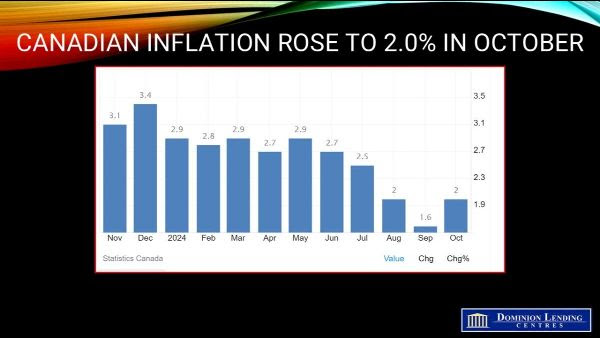
October Inflation Rose to 2.0% As Gasoline Price Declines Were More Muted

The Consumer Price Index (CPI) rose 2.0% year-over-year in October, up from a 1.6% increase in September. Gasoline prices fell to a lesser extent in October (-4.0%) compared with September (-10.7%). The all-items CPI, excluding gasoline, rose 2.2% in October, the same growth rate as in August and September.

The smaller decline is partly attributed to a base-year effect, as prices fell 6.4% month over month in October 2023, stemming from lower refining margins and weaker global oil consumption.

On a monthly basis, prices for gasoline were up 0.7% in October, following a 7.1% decline in September.

Slower rise in shelter prices

Shelter price growth continued to ease in October, rising 4.8% year over year, compared with a 5.0% increase in September. Slower price growth in the mortgage interest cost index in October (+14.7%) compared with September (+16.7%) applied downward pressure on the shelter component. Mortgage interest costs have been decelerating year-over-year since September 2023, following a peak in August 2023 (+30.9%).

Similarly, rent prices grew at a slower pace in October, increasing 7.3% on a year-over-year basis, following an 8.2% gain in September. Nova Scotia (+5.2%) and Manitoba (+6.5%) decelerated the most. Although slowing, rent prices continue to increase and remain elevated. Compared with October 2021, rent prices increased 21.6%.


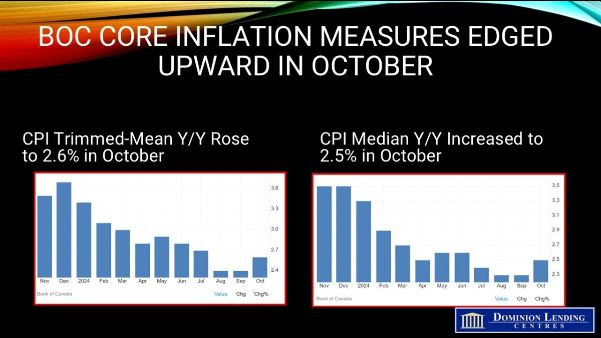
The central bank’s two preferred core inflation measures also quickened, averaging 2.55% yearly pace, faster than expectations and up from 2.35% a month earlier. According to Bloomberg calculations, a three-month moving average of those measures rose to an annualized pace of 2.8% from 2.1% in September.

After the release, overnight swaps traders trimmed their bets for a second consecutive large rate cut to about one in three, from a little less than a coin flip previously.

Bottom Line

The first acceleration of headline inflation in five months may bolster a case for the Bank of Canada to reduce borrowing costs gradually. After officials stepped up the pace of easing in October with a half-point cut, the next and this year’s final rate decision is on Dec. 11.

Still, Tuesday’s inflation print didn’t eliminate bets for another jumbo rate cut. That’s because the central bank had already expected a bump along the road, with consumer prices hovering around 2%, as policymakers keep cutting rates to boost economic growth.

When Governor Tiff Macklem and his officials delivered their outsize rate cut last month, they said they wanted to see a pickup in growth and demand. Preliminary industry-based data point to 1% annualized GDP growth in the third quarter, below the central bank’s 1.5% estimate. Final expenditure-based gross domestic product data is due at the end of this month.

The November employment report, released on December 6, is another critical data point for the central bank. The unemployment rate has been steady at 6.5% for the past two months. A meaningful rise in the jobless rate could encourage the Governing Council to go another 50 bps lower at their next meeting. That and GDP figures (released on November 29) will be watched closely to game the Bank of Canada’s next move. A 25 bps cut in the overnight policy rate is in the bag. A 50-bps cut is less likely.

Either way, the overnight policy rate, now at 3.75%, will be cut to roughly 2.5% by the middle of next year. This will continue to spur housing activity and could augur for a robust spring housing season.


Angela Calla is an 19-year award-winning woman of influence which sets her apart from the rest. Alongside her team, Angela passionately assists mortgage holders in acquiring the best possible mortgage. Through her presence on “The Mortgage Show” and through her best-selling book “The Mortgage Code, Angela educates prospective home buyers by providing vital information on mortgages. In light of this, her success awarded her with the 2020Business Leader of the Year Award.

Angela is a frequent go-to source for media and publishers across the country. For media interviews, speaking inquiries, or personal mortgage assistance, please contact Angela at hello@countoncalla.ca or at 604-802-3983.

Click here to view the latest news on our blog. 
 

Bank of Canada Rate Cuts and Your Mortgage

General Angela Calla 28 Oct

Exciting times ahead in the world of mortgages! On Global News this past week, I discussed how VRM (Variable Rate Mortgage) holders can benefit from the recent rate cuts and how it compares to an ARM (Adjustable Rate Mortgage). With so many details affecting the cost of borrowing, understanding the terms of your mortgage is essential! Mortgage Renewals need this unbiased advice to avoid costly mistakes while navigating our changing market.

While fixed rates are also down, they’re tied to the bond market—NOT this latest 50bps decrease.

As an independent, unbiased broker, our team helps clients explore all their options to find the best fit for their unique situation.

Now is a fantastic time to create a purchase plan, especially as rates continue to fall and new affordability measures take effect. Whether you’re looking to save on closing costs with a new build, plan for a down payment, or just explore options, my team and I are here to help.

For 20 years, it’s been a pleasure assisting our clients in securing their financial futures, and we are looking forward to the next 20.

Click on the image below for the segment.


Angela Calla is an 19-year award-winning woman of influence which sets her apart from the rest. Alongside her team, Angela passionately assists mortgage holders in acquiring the best possible mortgage. Through her presence on “The Mortgage Show” and through her best-selling book “The Mortgage Code, Angela educates prospective home buyers by providing vital information on mortgages. In light of this, her success awarded her with the 2020Business Leader of the Year Award.

Angela is a frequent go-to source for media and publishers across the country. For media interviews, speaking inquiries, or personal mortgage assistance, please contact Angela at hello@countoncalla.ca or at 604-802-3983.

Click here to view the latest news on our blog. 

Latest Bank of Canada Rate Announcement & What It Means for You

General Angela Calla 23 Oct

This morning, the Bank of Canada made its highly anticipated announcement, confirming a 50 basis point decrease in interest rates.  Bank Prime is expected to follow from its current 6.45% down to 5.95% for most banks.  We are here to explain exactly what this means for you and how you can benefit from these changes.


How Does This Impact You?

• For those with an adjustable-rate mortgage, this decrease could lower your monthly payments on a $500,000 mortgage by approximately $150 a month.

• If you’re approaching your mortgage renewal, now is the time to reassess your options. This rate change opens up the opportunity to secure a lower rate and save thousands over the life of your mortgage.

• Looking to buy? This rate cut, combined with recent federal mortgage changes, could improve your qualification chances and increase your purchasing power, just as the market presents unique buying opportunities with more inventory.


Read the official press release from the Bank of Canada here


The next rate announcement is scheduled for December 11th, so this is the perfect window to review your current mortgage strategy. We’re here to help with:


• Mortgage reviews to ensure you’re maximizing savings

• Refinancing or renewals to secure the best available rates

• Home purchase options for buyers looking to take advantage of this favorable moment


As your Mortgage Broker, one of the many benefits for ANY mortgage is as rates continue to decrease, we do a full look back upon closing to ensure the lowest rate while protecting your credit.

Additionally, if you’d like to review other financial strategies outside of your mortgage, such as retirement planning, wealth protection, or tax strategies, we’re happy to introduce you to our trusted financial planning partners. This holistic approach can help you build and protect wealth for the future.

Please don’t hesitate to reach out if you have any questions or would like a personal review of your mortgage options. We’re here to ensure you get the best outcome!


Angela Calla is an 19-year award-winning woman of influence which sets her apart from the rest. Alongside her team, Angela passionately assists mortgage holders in acquiring the best possible mortgage. Through her presence on “The Mortgage Show” and through her best-selling book “The Mortgage Code, Angela educates prospective home buyers by providing vital information on mortgages. In light of this, her success awarded her with the 2020Business Leader of the Year Award.

Angela is a frequent go-to source for media and publishers across the country. For media interviews, speaking inquiries, or personal mortgage assistance, please contact Angela at hello@countoncalla.ca or at 604-802-3983.

Click here to view the latest news on our blog. 

October 2024 Newsletter

General Angela Calla 9 Oct

Welcome to the October issue of my monthly newsletter!
It’s spooky season, but thankfully with the latest Bank of Canada rate cuts, your mortgage doesn’t have to be! Find out what the decreased interest rates mean for you, plus check out my tips to alleviate your financial stress this Fall.

Scroll down for all the details!

What the Bank of Canada Rate Drops Mean for YOU!

With the Bank of Canada rate decreases throughout the summer and into September, I thought this would be a great opportunity to update you on what this means for your mortgage.

If you’re on an adjustable-rate mortgage, this will result in a slight decrease in your mortgage payments, giving you more cash flow each month!

For example, if your mortgage balance is $750,000 at the previous 6.20% interest rate your approx. compounded monthly payment was likely around $4,924. With the new rate of 5.95% your approx. compounded monthly payment on an adjustable-rate mortgage will be $4,809*. This is an estimated $115/m decrease ($15/m per 100k balance) on your payment. While it may not seem like much, it can certainly add up over time resulting in hundreds of dollars in savings.

*Rates based on example of Prime minus .50% (old prime 6.70 and new prime 6.45)

Borrowers with static-payment variable-rate mortgages will also benefit from Bank of Canada rate decreases. While the monthly payment stays the same on these types of mortgages, the lower interest rate means that more of your monthly payment will go towards paying down your mortgage principal, and less will go towards interest.

Fixed-rate mortgages do not change when the Bank of Canada increases or decreases rates. However, if you have a fixed-rate mortgage, this declining rate environment could make it easier when it comes time to renew or refinance your mortgage. Lower rates give you more borrowing power in the market – this means your money can go further!

Recent changes are also great news for first-time buyers! Not only does a lower interest rate allow for more qualification options and lower payments, but recent Government of Canada changes on mortgage rules have removed many barriers previously faced by first-time home buyers.

The Bank of Canada has two more decision dates this year in October and December. Experts anticipate the Bank of Canada will continue these quarter-point rate cuts, taking the overnight rate down to 4.0% at year-end and potentially down to 2.75% next year.

Whether you’re a current homeowner, looking to refinance or renew, or wanting to purchase, this is exciting news for Canadians across the country!

However, keep in mind rate is not the be-all-end-all of mortgages. Factors such as type of mortgage, down payment amount, payment schedule, amortization, prepayment penalties, and more will also affect your mortgage and affordability.

If you want more information about your specific mortgage and how this changing environment affects your situation, please don’t hesitate to reach out!

5 Tips to Manage Financial Stress

Despite the Bank of Canada taking steps to reduce interest rates, many Canadians still feel pressure due to the overall cost of living and inflation. This uncertainty can be unnerving for many individuals, but don’t fret!

I have some tips and suggestions to help you manage your financial stress and help you to power through these latest economic changes:

  1. Prioritize What You Can Control: It can be easy to feel like you have no control over your financial situation, especially with the economy in flux. However, dwelling on things you cannot fix will only cause more stress. Instead, we recommend focusing on what you CAN control within your situation. For instance, take a looking at your phone bill and services to see if you can reduce the cost (even temporarily), reviewing your grocery bill and looking for places to switch to cheaper brands or alternatives, perhaps buying in bulk. You’ll not only save money, but you will feel like you have more control and help reduce stress.
  2. Pay Essential Bills: If you are struggling to pay your monthly bills, prioritizing them can help you gain some control. Knowing which bills are most important to pay first can help reduce anxiety as you’re not scrambling to decide what to do. In some cases, prioritizing your bills can also help you uncover unnecessary spending and you may find something that can be eliminated entirely (even temporarily).
  3. Automate Payments and Savings: If you’re struggling to keep up with your bills and payments, or are finding that you keep saying you’ll save money, but aren’t, considering automation for your finances can be a step in the right direction. Ensuring that your bills are paid on time will help reduce stress and protect you from wasting money on penalties for missed payments. Alternatively, you can also set up automatic money transfers on the days you are paid to move funds into a separate, savings account before you even see it. Thereby, reducing the likelihood that you’ll skip adding to your savings that month or use that money elsewhere.
  4. Find Ways to Earn More Money: When cashflow is a problem and you are feeling the strain of trying to afford your current lifestyle, looking for ways to earn additional money can be a lifesaver! Consider part-time work for the weekends, consulting in your area of expertise or picking up extra hours at your current place of work. Now is also a great time to discuss with your manager if you are due for a raise.
  5. Talk to Your Mortgage Professional: For most people, their mortgage is their largest monthly bill. If you are feeling the financial crunch, now is a great time to talk to meabout potentially changing your payment schedule or even looking for a different mortgage product with better rates (ideally if you are at the end of your term). Do not hesitate to be honest about your situation and ask what your options are.

Regardless of where you find yourself financially, there are often many solutions to help reduce and resolve your stress and ensure that you have healthy monthly cashflow.

Economic Insights from Dr. Sherry Cooper

Two significant developments in September will have a lasting positive impact on Canadian housing activity. First were Ottawa’s measures to make housing more affordable. Second was the Fed’s 50 basis point rate cut.

Ottawa has come under increasing pressure to reduce immigration, build more housing, and help first-time homebuyers afford to buy a home. In response, the federal government increased the home price cap for insured mortgages from $1 million to $1.5 million. This is the first time the home value limit has been raised since 2012.

This will allow many more home purchasers to buy with a smaller downpayment (10% rather than 20%) and 30-year amortizations (up from 25 years for non-insured mortgages).

  • A $1.5 million home will now require a $125,000 down payment (8.33%). That’s less than half the current $300,000 required ante (assuming the feds keep the minimum down payment tiers the same)
  • The maximum insurance premium on a $1.5 million purchase with 30-year amortization will now be $57,750 (again, assuming 10% down on any purchase price portion over $500,000).

This will significantly impact high-cost real estate markets such as Vancouver and Toronto, where the selling prices average $1.1 million in Toronto and $1.2 million in Vancouver. In addition, all insured new-build buyers can get 30-year amortizations, not just first-time buyers.

With mortgage rates falling rapidly, these measures will accelerate the growth in housing demand.

Also, the good news was the Federal Reserve’s 50 basis point rate cut, the first such cut in this cycle. Fifty is double the usual policy change increment. Such moves are typically reserved for emergency Fed meetings or clear and present liquidity threats. This opens the door for the Bank of Canada to have a super-sized rate cut in October or December. This bodes well for building home sales going into the all-important spring season.

Inflation has fallen considerably, and the Canadian unemployment rate has risen sharply. While retail sales for July showed a considerable rebound, it was mainly because of a surge in car sales. Nonetheless, spending growth pales in comparison to the population surge.


Angela Calla is an 19-year award-winning woman of influence which sets her apart from the rest. Alongside her team, Angela passionately assists mortgage holders in acquiring the best possible mortgage. Through her presence on “The Mortgage Show” and through her best-selling book “The Mortgage Code, Angela educates prospective home buyers by providing vital information on mortgages. In light of this, her success awarded her with the 2020Business Leader of the Year Award.

Angela is a frequent go-to source for media and publishers across the country. For media interviews, speaking inquiries, or personal mortgage assistance, please contact Angela at hello@countoncalla.ca or at 604-802-3983.

Click here to view the latest news on our blog. 

Navigating Clients Through Mortgage Changes

General Angela Calla 7 Oct

Navigating your clients through change to assist with homeownership goals

Recent changes in the housing market present exciting opportunities for homebuyers. As a realtor, your role is crucial in guiding clients through these updates, helping them build effective plans to achieve their homeownership goals by having them reach out to a mortgage broker to see what they are able to afford.

Knowing these new rules and guidelines will help with strategy and future goals of climbing the “real estate ladder.”

Expanded amortizations for first-time homebuyers

Starting December 15, first-time homebuyers will have access to 30-year amortizations. This change can benefit your clients in two significant ways:

1. Lower income requirement. By extending the amortization period, the income required to qualify for a home purchase decreases. This means more clients can meet the necessary criteria.

2. Reduced monthly payments. Clients will experience a decrease in their monthly payments, making homeownership more financially manageable. For instance, on a $600,000 purchase, the monthly payment could drop by approximately $250, providing greater flexibility in budgeting.

Increased insured mortgage cap to $1.5 million

For clients with high incomes but difficulties saving for a down payment, the increase in the insured mortgage cap to $1.5 million can accelerate their path to homeownership. Previously, purchasing a $1.4 million home required a down payment of $280,000. Now, as of December, clients can potentially purchase the same property with a down payment of about $115,000 — a savings of $165,000.00 in upfront requirements.

This change is also advantageous for “right-sizers” looking to downsize. It allows them to allocate more funds from the sale of their larger home toward retirement, as they can put less down on a new, smaller property. However, clients should keep in mind that closing costs, typically around 3.0 per cent of the purchase price, need to be accounted for in each scenario.

For a $600,000 purchase price, anticipate that clients will need an annual income of approximately $150,000 to meet today’s stress-test requirements.

Switching lenders at renewal: A business opportunity

While you may not initially think about how switching lenders can benefit your business, it’s essential to understand that mortgages encompass more than just interest rates. The Canadian Mortgage Charter now allows insured mortgage holders to switch lenders at renewal without undergoing a stress test. This change opens up opportunities for borrowers to shop around for better rates and terms, potentially saving them thousands of dollars.

Encourage your clients to consider lenders that don’t adhere to posted rates. This strategy can significantly reduce Interest Rate Differential (IRD) penalties.

Case in point

For example, let’s compare a $1 million mortgage with three years left on a five-year term at a 5.0 per cent interest rate:

Big bank Monoline lender
Original rate 5% 5%
Current rate 3.5% 3.5%
IRD penalty calculation (5% – posted 2%) x 3 years (5% – 3.5%) x 3 years
Total IRD penalty $55,000 $30,000


By choosing a monoline lender (provided qualifications are met), your client could save $25,000 in IRD penalties, allowing them to manage financial changes better and seize new opportunities.

Tax-efficient savings strategies

As well, two important tax-efficient savings methods have emerged that can empower your clients on their journey to homeownership:

1. RRSP withdrawal limit increase. The amount that can be withdrawn from an RRSP has increased from $35,000 to $60,000 per borrower. This change provides additional funds for clients to put toward their down payments.

2. First-time home saver account. Introduced in 2023, this account allows clients to save $8,000 per year in contribution room, which reduces their taxable income. Unlike RRSP withdrawals, funds from this account do not need to be repaid and any gains earned within it are tax-free. This account, however, has a sunset clause in 2028, making it vital for clients to act quickly to maximize its benefits.

These recent changes create valuable opportunities for your clients. By understanding the implications of expanded amortizations, increased mortgage caps, flexible lender options and tax-efficient savings strategies, you can help them make informed decisions on their path to homeownership.


Angela Calla is an 19-year award-winning woman of influence which sets her apart from the rest. Alongside her team, Angela passionately assists mortgage holders in acquiring the best possible mortgage. Through her presence on “The Mortgage Show” and through her best-selling book “The Mortgage Code, Angela educates prospective home buyers by providing vital information on mortgages. In light of this, her success awarded her with the 2020Business Leader of the Year Award.

Angela is a frequent go-to source for media and publishers across the country. For media interviews, speaking inquiries, or personal mortgage assistance, please contact Angela at hello@countoncalla.ca or at 604-802-3983.

Click here to view the latest news on our blog. 


September 2024 Newsletter

General Angela Calla 27 Sep

Welcome to the September issue of my monthly newsletter!
It is already September and I am excited to share my latest newsletter with you! This month, I have some details about the upcoming Fall market, along with expert tips for staging your home! Scroll down for all the details and have a great month.

2024 Fall Market Outlook

The initial Bank of Canada rate cuts this past summer did not spur housing activity as anticipated, but potentially more on the way will continue to affect the housing market outlook. New listing levels are expected to rise as sellers who may have held back enter the market with the hope that lower mortgage rates will attract additional buyers.

While the current Bank of Canada rate of 4.5% may still not be enough to make a dent in home affordability, it does provide a glimmer of hope for potential buyers as interest rates continue to fall.
Canadians across the country are anxiously awaiting additional rate cuts, promoting future home affordability. While consumer confidence is beginning to rise, mortgage affordability will need to be balanced with rising unemployment to reduce the number of households with strained budgets.
In addition, while home prices have cooled a bit, home prices in Canada remain among the highest in the world’s most advanced economies (Japan, France, Germany, Italy, and the UK). These still -high prices have resulted in many potential first-time home buyers to withdraw for now. Higher property taxes, higher qualifying stress-test rates, and the current wave of mortgage renewals will also factor into how successful the Fall market will be.
In 2023 alone, the country saw an influx of 46% of new Canadians, which also contributes to housing demands and pricing. As rates continue to drop, the hope is that prices will stabilize owing to increased supply as demand rises.
If you are looking to get into the housing market as a buyer or seller, or simply have questions so you can best prepare yourself for a future move, don’t hesitate to reach out to me!

Expert Tips for Staging Your Home

Even in a sellers’ market, there are some ways you can improve your chances of increasing the number of offers and selling your home for the best value.

Check out these expert tips for staging your home to help make the best first impression possible:

  1. Clean and Declutter: Clean, clean, and clean some more! While you might not be able to stage each room in your home, it is vital to ensure that each space is cleaned and decluttered. Especially ensure that counters, carpets, flooring, and appliances are spotless! This not only signals pride of ownership, but it helps display the potential of the spaces to buyers.
  2. Depersonalize: While you’re working through and cleaning your spaces, make sure to depersonalize along the way. Ideally, any family photos, kids’ drawings, etc, should be removed or replaced with more general photography to better appeal to potential buyers.
  3. Focus on Key Spaces: The primary areas in your home are your living room, kitchen, dining room, and master bedroom. If you are not able to get to each room, these are the ones you should focus on to ensure your home is represented as best as possible.
  4. Consider a Fresh Coat: Did you know? According to a RE/MAX Canada Renovation Investment Report, 36% of buyers prefer a fresh coat of paint! This can go a long way to making your home look new and revitalized.
  5. Boost Curb Appeal: While you’re staging your home, don’t forget about curb appeal! The exterior of your home is just as important as the interior – if not MORE important for first impressions. A good place to start would be renting a power washer to scrub down your driveway and exterior walls.

Economic Insights from Dr. Sherry Cooper

As the Bank of Canada cuts interest rates, housing activity has remained relatively weak. Existing home sales were well below historical averages in July, while new listings edged upward. Prices have plateaued, and residential mortgage originations are tepid.

Mortgage balances grew by 3% annually in Q2, the second slowest quarterly pace since 2000.

This portends a further dip in household debt-to-income ratios—welcome news, as elevated leverage drives household financial vulnerability. The central bank is widely expected to continue to cut the overnight policy rate at the remaining meetings this year and well into 2025. Monetary policy remains highly restrictive, with the policy rate at 4.5%, well above the 2.5% inflation rate.

We believe interest rates will continue to fall as the overnight rate heads for 2.75%. By later this year, housing activity is likely to pick up gradually.

In the meantime, Canadian homebuilding remains sturdy despite softness in the resale market and ongoing capacity pressures. Housing starts surged again in July. The data series is volatile, but the trend is strong at just under its recent all-time highs posted in 2021. The strength of residential starts has been dominated by multi-unit construction, while single-family starts have historically been very weak.

The home construction sector has suffered ongoing capacity pressures, including a shortage of construction workers, zoning restrictions and supply bottlenecks. These capacity pressures have delayed housing completions, bringing the number of dwellings under construction to fresh record highs.

Homebuilding has remained remarkably resilient, albeit at a much slower pace than the torrid population growth. The government plans to cool the growth in temporary immigration, but the Bank of Canada recently suggested that the slowdown is likely to be delayed and smaller than originally projected.

Meanwhile, Canadian labour markets are easing. Job vacancy rates have plunged, and unemployment has risen, especially for young workers and new immigrants.

Economic growth has slowed to about 1% this year and will pick up only moderately next year. Inflation is falling without a recession. To be sure, some sectors have slowed meaningfully, especially manufacturing. Canadian businesses are bracing for billions of dollars in losses if the country’s two national railways shut down this week.

More than 9,000 workers at Canadian National Railway Co. and Canadian Pacific Kansas City Ltd. could either be on strike or locked out if no labour agreement is reached by Thursday, disrupting the supply chain industries.

Housing markets will begin to recover as lower interest rates do their job this fall.


Angela Calla is an 19-year award-winning woman of influence which sets her apart from the rest. Alongside her team, Angela passionately assists mortgage holders in acquiring the best possible mortgage. Through her presence on “The Mortgage Show” and through her best-selling book “The Mortgage Code, Angela educates prospective home buyers by providing vital information on mortgages. In light of this, her success awarded her with the 2020Business Leader of the Year Award.

Angela is a frequent go-to source for media and publishers across the country. For media interviews, speaking inquiries, or personal mortgage assistance, please contact Angela at hello@countoncalla.ca or at 604-802-3983.

Click here to view the latest news on our blog. 


August 2024 Newsletter

General Angela Calla 27 Sep

Welcome to the August issue of my monthly newsletter!
I hope you’ve had a fantastic summer so far! This month, I am excited to give you some tips on paying off your mortgage faster. Plus, learn my favourite ways to cut energy costs and save. Scroll down for all the details and have a great month!

How to Pay Off Your Mortgage Faster

When it comes to homeownership, many of us dream of the day we will be mortgage-free. While most mortgages operate on a 25-year amortization schedule, there are some ways you can pay off your mortgage quicker!

Did you know? There are a few ways you can help pay off your mortgage faster

For example – switching to an accelerated bi-weekly payment schedule, increasing your monthly mortgage payments to pay more to the principal, making extra payments on your mortgage, negotiating a better rate, or refinancing to a shorter amortization period!

Let’s take a look at the options and how they work:

  1. Review Your Payment Schedule: Taking a look at your payment schedule can be an easy way to start paying down your mortgage faster, such as moving to an accelerated bi-weekly payment schedule. While this will lead to slightly higher monthly payments, the overall result is approximately one extra payment on your mortgage per calendar year. This can reduce the total amortization by multiple years, which is an effective way to whittle down your amortization faster.
  2. Increase Your Mortgage Payments*: This is another fairly simple change you can execute today to start having more of an impact on your mortgage. Most lenders offer some sort of pre-payment privilege that allows you to increase your payment amount without penalty. This payment increase allowance can range from 10% to 20% payment increase from the original payment amount. If you earned a raise at work, or have come into some money, consider putting those funds right into your mortgage to help reduce your mortgage balance without you feeling like you are having to change your spending habits.
  3. Make Extra Payments*: For those of you who have pre-payment privileges on your mortgage, this is a great option for paying it down faster. The extra payment option allows you to do an annual lump-sum payment of 15-20% of the original loan amount to help clear out some of your loans! Some mortgages will allow you to increase your payment by this pre-payment privilege percentage amount as well. This is another great way to utilize any extra money you may have earned, such as from a bonus at work or an inheritance.
  4. Negotiate a Better Rate: Depending on whether you have a variable or a fixed mortgage, you may want to consider looking into getting a better rate to reduce your overall mortgage payments and money to interest. This is ideally done when your mortgage term is up for renewal and with rates starting to come back down, it could be a great opportunity to adjust your mortgage and save! This may be done with your existing lender OR moving to a new lender who is offering a lower rate (known as a switch and transfer).
  5. Refinance to a Shorter Amortization Period: Lastly, consider the term of your mortgage. If you’re mortgage is coming up for renewal, this is a great time to look at refinancing to a shorter amortization period. While this will lead to higher monthly payments, you will be paying less interest over the life of the loan. If you’re interested in this, connect with me today so we can calculate if it is worthwhile for you to take advantage! Knowing what you can afford and how quickly you want to be mortgage-free can help you determine the best new amortization schedule.

*These options are only available for some mortgage products. Check your mortgage package or reach out to me to ensure these options are available to you and avoid any potential penalties.

If you’re looking to pay your mortgage off quicker, don’t hesitate to call me to go over your options in more detail today!

Smart Ways to Cut Your Energy Costs

In the last decade, climate change and energy efficiency have become top of mind for many Canadians. From wanting to do our part by recycling to making our home as energy efficient as possible, there are so many benefits to being environmentally and energy conscious.

If you are looking to cut costs or simply want to reduce your eco-footprint, here are some great ways to cut your energy costs:

  • Get a Smart Thermostat: A pretty easy installation, a smart thermostat can help you better manage your in-home temperature. Whether you opt to install a basic programmable thermostat or try Google’s Nest, which learns from you and works to predict which temperatures you prefer and when, getting a read on your in-home temperature can help you better manage your energy usage.
  • Look for Drafty Spots: When it comes to heating your home, it can quickly become a wasted effort and results in extra costs if you have drafts in your home. In addition to windows and doors, you should also seal any folding attic stairs, add a fireplace plug to seal the damper and install a dryer vent seal to reduce drafts in your laundry room.
  • Swap to LEDs: Most of us are already using LED bulbs throughout our home. If you aren’t yet, now is the time to make the switch! LED bulbs use 15% less energy than an equivalent incandescent, which can save you a ton of money each month especially in larger homes.
  • Turn Down Your Water Heater: While sometimes nothing beats a good scalding shower, you don’t want to be burned with a high energy bill. Did you know if you knock down that temperature gauge by just 10 degrees, you can save 3% to 5% on your bills each month!?
  • Examine Your Appliances: Since 1992, ENERGY STAR® has been backing energy efficient appliances and products, helping consumers make the right choices. Some of the least green appliances in your home are your dishwasher, washing machine, dryer and refrigerator and, if you don’t currently have Energy Star certified versions of these machines, swapping to them is a surefire way to reduce your monthly expenses.Can’t afford new appliances? Here are some other tips and tricks to help make them more efficient in the meantime:
    • Dishwasher: Use a citric acid-based cleaner in an empty cycle to rid your dishwasher of excess soap and calcium buildup that may be causing your machine to work harder.
    • Washing Machine: Maximize energy by stuffing your machine to the brim whenever possible as washing machines typically use the same amount of energy regardless of load size.
    • Dryer: For starters, ensure you are always cleaning out your lint filter to increase air circulation. In addition, keep an eye on the outside exhaust and clean when needed to reduce drying time and save energy.
    • Refrigerator: While most of us are more concerned with the food inside our fridges than the parts, it is important to check your condenser coils. Over time, dirt, food particles and dust can collect and reduce the efficiency. Another tip is to set your refrigerator to 2-3 degrees Celsius.
  • Close The Blinds: When the temperature starts heating up, it is important to close the blinds and drapes to prevent the sun from beating in and warming up your home. The excessive heat makes your air conditioner work overtime causing your energy bills to skyrocket.

In addition to the cost savings and environmental benefits of improving your energy efficiency, CMHC also has a rebate available! The CMHC Eco Plus refund can provide a 25% partial premium refund if you’re CMHC insured and buying or building an energy-efficient home! Click here for more details.

Economic Insights from Dr. Sherry Cooper

All eyes were on The Bank of Canada last month as they cut interest rates by 25 basis points again during their July 24th meeting, thereby taking the overnight policy rate down to 4.5%.

We believe that owing to a sustained deceleration in inflation, the central bank will continue its monetary easing at the September and December meetings and well into next year.

The policy rate will likely fall to 2.75% next year, reducing the burden of higher monthly mortgage rates on renewals in the next 18 months.

The influx of roughly 2 million immigrants to Canada has raised overall consumer spending, averting a recession this year, but GDP per capita continues to decline.

Labour markets continue to soften as job vacancies have fallen sharply, and the jobless rate has risen from 4.9% to 6.4%. The latest business and consumer surveys have suggested that inflation expectations have fallen and wage inflation—a lagging indicator—will soon decline. Companies expect to cut their spending on machinery and equipment, and commercial real estate valuations have fallen owing to the sharp rise in office vacancy rates.

Housing market activity has slowed with the run-up in interest rates from March 2022 until June 2024. Lower interest rates will spur transactions and increase new listings next year. Housing affordability will improve as price pressures remain muted. The housing shortage, however, will likely mitigate the improvement, particularly as the shortage of experienced construction workers impedes rapid housing supply increases.


Angela Calla is an 19-year award-winning woman of influence which sets her apart from the rest. Alongside her team, Angela passionately assists mortgage holders in acquiring the best possible mortgage. Through her presence on “The Mortgage Show” and through her best-selling book “The Mortgage Code, Angela educates prospective home buyers by providing vital information on mortgages. In light of this, her success awarded her with the 2020Business Leader of the Year Award.

Angela is a frequent go-to source for media and publishers across the country. For media interviews, speaking inquiries, or personal mortgage assistance, please contact Angela at hello@countoncalla.ca or at 604-802-3983.

Click here to view the latest news on our blog. 


Banking Regulator to Relax Stress-Test

General Angela Calla 25 Sep

Banking regulator to relax stress-test rules for homeowners switching lenders at mortgage renewal.

Canada’s banking regulator is set to relax mortgage rules for homeowners who switch banks when they renew their loans.

The Office of the Superintendent of Financial Institutions (OSFI) will no longer require banks to apply the mortgage stress test on borrowers who switch lenders if they are simply renewing their loan, the regulator told The Globe and Mail on Wednesday.

The change, which is due to take effect Nov. 21, will make it easier for borrowers with uninsured mortgages to move to a different bank at renewal. It is also expected to motivate banks to offer cheaper mortgage rates in order to retain their current borrowers and attract new customers.

The change marks a significant win for the mortgage industry, which had been pushing for this relief in the face of rising interest rates.

When borrowers take out their initial mortgage, they must pass the federal mortgage stress test or prove they have enough income to cover their mortgage payments at an interest rate that is two percentage points higher than their actual loan contract.

When the mortgage term ends and they have to renew their loan, borrowers must again pass the mortgage stress test if they want to switch to a different lender because the borrower is new to that lender. That rule stands even if the renewal is a “straight switch,” which means the borrower will remain on the same amortization schedule and is not lengthening the time they will take to pay off their mortgage or increasing the amount of their loan.

But because mortgage rates more than doubled over the past two years to above 6 per cent at their height, borrowers had to prove they could make their loan payments with an interest rate of at least 8 per cent. That made it much more difficult for uninsured borrowers to pass the stress test if they renewed with a different lender.

“There isn’t reckless underwriting in straight switches,” OSFI Superintendent Peter Routledge said in an interview.

Currently, homeowners with insured mortgages are exempt from the mortgage stress test on straight switches because the insurer is protecting the bank if the homeowner misses mortgage payments. (A borrower must pay for mortgage insurance if they have made a down payment that is less than 20 per cent of the property’s purchase price.) But until now, borrowers with uninsured mortgages have still had to requalify if they switched lenders.

The difference in rules between insured and uninsured borrowers is one of the reasons that OSFI decided to make the change. “If I were that Canadian walking in with an uninsured mortgage, I kind of feel like that was an imbalance that wasn’t fair,” Mr. Routledge said. “Part of our job is to enable banks and lenders to take reasonable risks. And part of that reasonable risk-taking may involve treating an uninsured mortgager at renewal for a straight switch the same as an insured,” he said.

OSFI’s decision to eliminate the stress test on straight switches is occurring as the federal government relaxes other mortgage policies. Buyers will soon be allowed to put down smaller down payments on homes worth more than $1-million and first-time homebuyers will be allowed to stretch out their mortgage payments over 30 years instead of 25 on an insured mortgage.

Mr. Routledge said he does not think OSFI’s latest change will have any effect on the mortgage market credit risk or the housing market. He said the regulator has data showing that homeowners overwhelmingly stay with their lender when they renew their mortgages, which was also the case before mortgage stress test went into effect in 2018 for uninsured mortgages.

“I don’t view this as having discernible effect one way or the other,” he said.

The stress test has two thresholds: a minimum qualifying rate, or MQR, that is set by the regulator and an interest rate that is two percentage points higher than the borrower’s mortgage contract. The lender must use the higher interest rate to stress test the borrower. Since the MQR is currently set at 5.25 per cent, it is effectively obsolete because mortgage rates are currently around that level.

(Article courtesy of Rachelle Younglai, Real Estate Reporter)


Angela Calla is an 19-year award-winning woman of influence which sets her apart from the rest. Alongside her team, Angela passionately assists mortgage holders in acquiring the best possible mortgage. Through her presence on “The Mortgage Show” and through her best-selling book “The Mortgage Code, Angela educates prospective home buyers by providing vital information on mortgages. In light of this, her success awarded her with the 2020Business Leader of the Year Award.

Angela is a frequent go-to source for media and publishers across the country. For media interviews, speaking inquiries, or personal mortgage assistance, please contact Angela at hello@countoncalla.ca or at 604-802-3983.

Click here to view the latest news on our blog.